
Stephen Graham Jones is the NYT bestselling author of thirty-five or so books, and The Buffalo Hunter Hunter may well be the one for which he is ultimately remembered. Though Blackfeet, Jones was born in West Texas, and he teaches at the University of Colorado as the Ineva Reilly Baldwin Endowed Chair. His fiction has long occupied the blood-soaked frontier between Native American literature and horror — what scholars have described as “Rez Gothic” — and no book in his catalog maps that terrain more deliberately than this one. Jones cites the novels of Louis L’Amour as an influence on his development as a writer, stating that those pulp westerns are now part of his DNA. That inheritance haunts every page here, transmuted into something darker and more necessary.
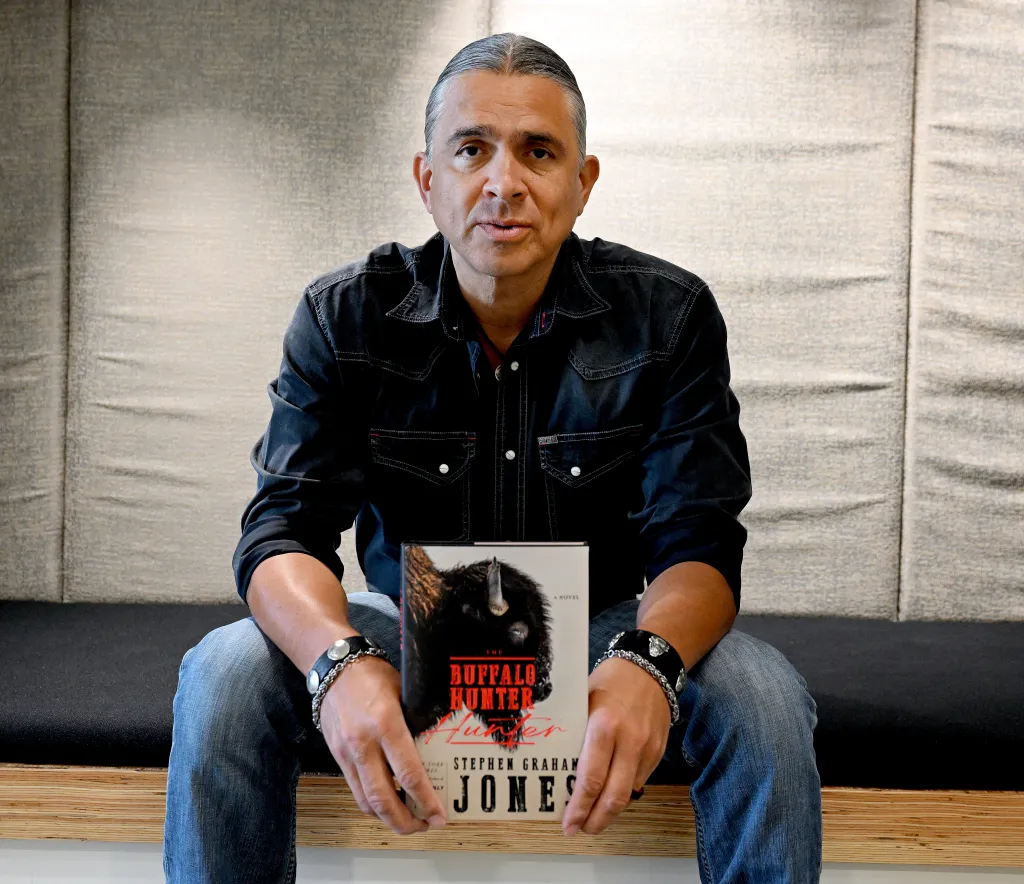
A professor unravels a mystery from the darkest depths of the Wild West in this ambitious, century-spanning American Gothic. Jones has always been a writer of ceremony and sorrow, and here he arranges both into something that feels less like a novel and more like an exhumation.
In 2012 Montana, a young academic named Etsy Beaucarne discovers the diary of her ancestor, Pastor Arthur Beaucarne. In 1912 Montana, the pastor finds a stranger in his congregation — a Blackfoot man dressed in the dark robes of a priest. This is Good Stab, and he has a tale to tell, but only through confession. What unfolds is a gospel of revenge written in snow and blood.
Stories within stories, each an iteration of the other — of Good Stab’s vengeance against the hunters and soldiers, of Arthur’s complicity and greed, of the creature’s hunger, of modernity’s unquenchable progress. Jones deploys the vampire not as Gothic ornament but as something far more terrible: a mirror. The vampire reflects the hunger to take and own and slaughter thoughtlessly — to feed and selfishly consume and thereby live through the blood of the people until they’re extinguished.
While a vampire Western could easily have become a farce, Jones crafts it into a rich tapestry winding around questions of identity, heritage, and historical truth, all pivoting on a real historical atrocity — the Marias Massacre, where nearly 200 Native people were murdered by the U.S. Army in January 1870. By the final pages, the novel has become something close to ritual: grief made literature, history made wound, and horror made necessary. One of the decade’s essential American novels.